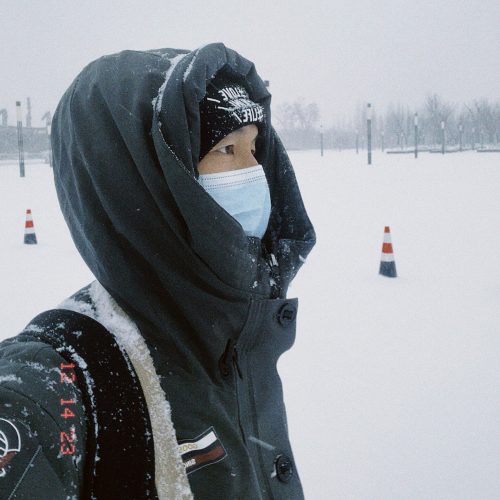
Long wooden tables form a quiet space for the interview in a library study room. Wei Jinchun, an educator at Guangzhou College of Applied Science and Technology, sits with his eyes lowered, gently resting his hands on a photobook titled Tangshan. His fingertips move slowly over the cover. His gaze is quiet and tender, as though the images on its pages are taking him back to a year of journeys between Tianjin and Tangshan, covering thousands of kilometers by motorcycle.
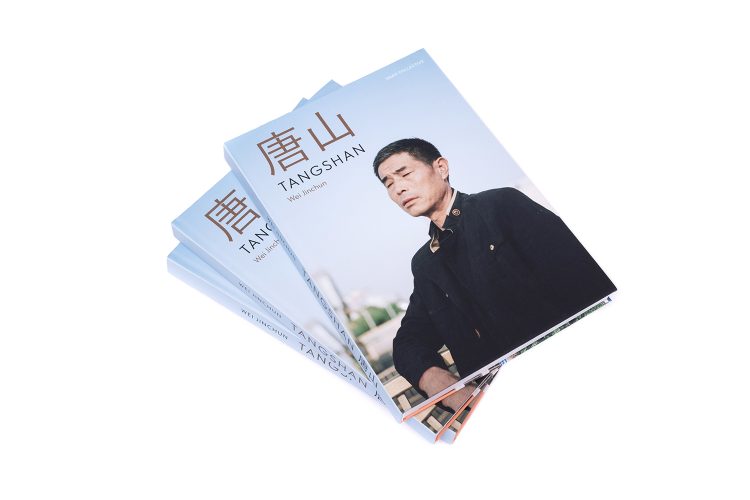
Looking at the photograph of a middle-aged Tangshan man with his eyes closed on the cover of Tangshan, Wei recalls the day he was selecting photographs. This image had held his gaze for a long time.“Many people would dismiss it as a failed shot based on conventional visual expectations. At first, I had my doubts about it too…”Yet the creative intuition that had prompted him to release the shutter only became clear through an extended conversation with his supervisor. Wei came to understand the closed eyes as a gesture of looking inward rather than numbness. They echoed Tangshan itself, taking the scars of the earthquake and the contradictions of the present into its inner life in a solemn act of self-examination.
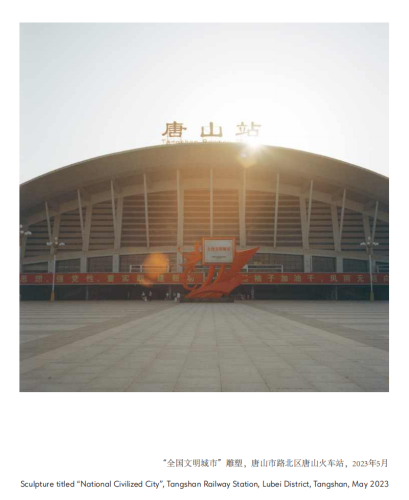
Made over a year and using more than 500 frames of film, the series has attracted sustained attention in China and internationally. It received an award for excellence at the fifth 1839 Photography Award, was shortlisted for LensCulture Critics’ Choice, and was shown at Photo London 2025. With a background in journalism, Wei went on to pursue a master’s degree in photography. Working from the perspective of an outsider from southern China, he used film to depict Tangshan’s ruins, new urban districts, and everyday street life. His photographs offer a more varied way of seeing a city so often defined by its earthquake, reconstruction, and industry.
Beginnings
In late March 2023, Wei accompanied his roommate, a Tangshan native, on a trip home to photograph ceramics. During a break, they visited Nanhu Park. To an ordinary visitor, its shimmering water, lush vegetation, and monumental bronze sculpture Danfeng Chaoyang presented a soothing landscape, every part of it suggesting a city reborn. But his roommate’s account revealed the weight of the city’s past beneath the water, planting in Wei the desire to investigate Tangshan.
According to the website of Tangshan’s Lunan District government, the Nanhu area was once a vast depression caused by a century of mining at the Kailuan coal mine. His roommate told him that after the 1976 earthquake, which abruptly claimed hundreds of thousands of lives, the subsided land also became a collective burial site for many of the victims.
Wei remembers the landscape lighting on the hills that night slowly brightening and dimming, like the earth breathing evenly. Colored light towers more than ten meters high rose among the trees, their somber halos moving through the shadows like countless eyes silently watching the land in the darkness.
The visual and emotional impact left Wei with an irrepressible urge to make work. He initially suggested that his roommate undertake a photographic exploration of his roots in Tangshan. But his roommate told him that this shock, cutting through the obscurity of history and reaching so deeply within, belonged to the observer who had come from afar: Wei himself.
Wei tells the interviewers that truly moving images never come from a calculated search. Choosing a subject to fit a predetermined plan rarely reaches the heart of things. Work that resonates comes instead from an instinct that arises naturally and cannot easily be suppressed. Tangshan gave him precisely this urge to photograph—something he felt compelled to express.
The city carries the collective trauma of the 1976 earthquake, a reminder of how small human beings are in the face of nature. Amid rapid urban development, it also confronts the unavoidable strains of the present. The 2022 barbecue restaurant assault exposed a hidden social fault line, revealing how difficult it can be for a modern society governed by law to resist the darker sides of human behavior. These complicated reflections between history and the present prompted Wei to examine the city through photography. Driven by a desire both to observe and to express what he saw, he used film to record Tangshan’s historical traces and contemporary urban landscape, creating the series Tangshan.
Film
From the day he decided to photograph Tangshan, Wei was certain he would use a Rollei twin-lens reflex film camera. In contrast to the ease with which digital images become intangible pixels, developed film offered a unique physical presence and a tangible warmth. Working with film also came at a considerable cost.“Each press of the shutter can cost ten yuan,”he says. That material expense, together with the irreversibility of each exposure, gave photographing an almost sacred sense of ritual. It compelled him to consider the composition repeatedly before releasing the shutter and to reflect on the urban context behind each image.
With this appreciation and respect for film, Wei traveled between Tianjin and Tangshan by motorcycle. His motorcycle was more than transport: it helped him enter local social circles and get closer to everyday Tangshan. He was struck by the fact that motorcycle customization competitions could be held in the city’s commercial plazas, unlike the strict controls on such modifications in other cities.
His motorcycle trips to photograph Tangshan brought him into contact with local riders. They traveled together late at night, rode to the Zhangbei grasslands, and shared meals and accommodation. The group had a rebellious, uninhibited energy. As Wei recalls, they rode so fast that“even with the throttle wide open, I couldn’t keep up with them.”Their free-spirited character helped Wei find his way into this Tangshan community. Eventually, he photographed an unfinished blue-green dragon tattoo on a young man’s back. To him, it was more than a portrait with a streetwise swagger: it offered a glimpse of the contemporary spirit of a heavy industrial city.
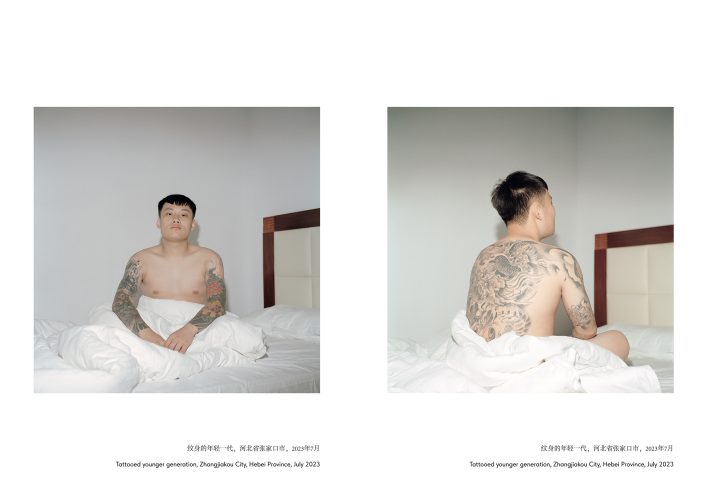
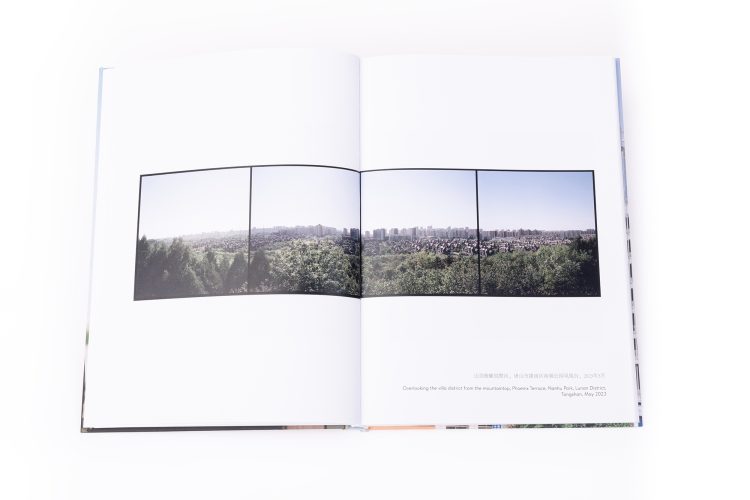
As he continued to travel and explore, Wei began to see Tangshan’s many overlapping faces. He encountered ruined buildings and old industrial sites that held the city’s past. Scattered bones lay silently among broken walls, facing distant factories where machinery had once roared. He also photographed the extensive renewal that followed the devastating earthquake: clusters of new buildings rising from the ground, an orderly network of streets opening across the city, and green grass set against the modern urban landscape in a striking visual tension.
Tangshan prospered through coal, grew amid the roar of heavy industry, and was rebuilt on the ruins left by the 1976 earthquake. Decades later, its buildings and roads have been renewed, yet historical trauma, industrial transformation, and the contradictions of everyday life remain within the city in different forms. When Wei climbed to a high point overlooking Tangshan, this coexistence of newness and incompleteness took the form of a specific image.
At sunset, a headless bodhisattva sat upright on a hilltop as the new city in the distance faded into dusk. It still held the posture of looking down over the city, but had neither a face nor a gaze.Wei says that, at that moment, he sensed Tangshan’s intense desire for renewal, yet felt that this renewal was somehow incomplete. A city can be rebuilt on its ruins, but some of its deeper scars may not disappear with the replacement of its buildings.
For him, this sense of incompleteness also echoed the shocks Tangshan had experienced in recent years. The 2022 barbecue restaurant assault exposed social problems beneath the city’s polished surface and prompted outsiders to reassess it. The headless bodhisattva offered no definitive answer to Tangshan, but became a metaphor through which Wei could understand the city:its outward renewal is clearly visible, while the work of repair within continues.
Voices
In February 2025, the WeChat public account Gudu Tushuguan published Wei’s photographs under the title “The Many Faces of Tangshan,” accompanied by his own commentary. The article soon exceeded 10,000 views. Work that had circulated mainly within contemporary photography circles now reached a wider local readership in Tangshan. Some readers thanked him for recording “details of Tangshan people’s lives that are disappearing or have already disappeared,” recognizing the sensitivity and patience such observation required. Others described seeing their hometown anew through an outsider’s lens as an experience both “familiar and unfamiliar.”
That familiarity began with people whose appearance was recognizable as local. In “The Many Faces of Tangshan,” Wei recounted an observation by a fellow photographer from the city. While looking through Tangshan, this photographer came across a black-and-white close-up and immediately concluded: “This man must be from Tangshan.”
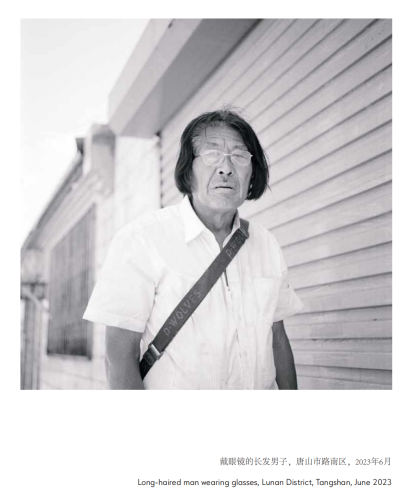
The man in the photograph has medium-length hair, a small mustache, and glasses, with a distinctive expression and style of dress. To this fellow photographer, people from Tangshan had a recognizable bearing: a well-fed build, a taste for making an impression, and an outgoing personality, sometimes expressed through conspicuous accessories such as thick gold chains.
These are hardly definitive regional criteria. Yet they suggest that, in local experience, being “from Tangshan” means more than household registration. It can also be expressed in clothing, physique, facial expressions, and ways of communicating. Wei’s photographs caught precisely these details—difficult to describe accurately, yet recognizable to local viewers.
A reader from elsewhere recognized similar local markers in the work. In a comment, he wrote that his stereotypical image of a Tangshan man was someone wearing a black T-shirt with a tiger’s head printed on the chest. The gently teasing remark echoed the clothing and everyday street atmosphere in the photographs. While local people might recognize identities through their experience of urban neighborhoods, outlying counties, or mining communities, outsiders often come to know a city through conspicuous outward signs.
For the same reason, “The Many Faces of Tangshan” also made some local readers uncomfortable. One asked bluntly: “Why does this look so much more provincial and run-down than the Tangshan I see every day?” Another remarked: “It feels so strange to see my hometown through someone else’s eyes.” Others called it “a sweeping generalization, negative and distorted,” arguing that the photographs deliberately magnified the city’s shortcomings and departed from its actual appearance.
Wei was initially puzzled by these responses. After taking time to reflect,he came to recognize that photography is never absolutely objective. Every choice of frame, every moment fixed in an image, reflects its maker’s perspective, understanding, and aesthetic position.Prosperity and simplicity, refinement and roughness, new life and traces of the past all coexist in a city. Tangshan preserves one cross-section of it, encountered through his sustained journeys and observation.
This personal view reminded Wang Meng, a reader from Tangshan, of Robert Frank’s photobook The Americans. Frank’s work depicted everyday life in 1950s America in ways that diverged from the dominant national narrative, and met with criticism when it was first published in the United States. Wang wrote on WeChat Moments: “My full understanding of Robert Frank actually began with Wei Jinchun’s Tangshan.”
For Wang, the real affinity between the two bodies of work lay neither in their subjects nor in their periods. It lay in a rawness that refused to give a place a neat, uniform face—stripping away the city’s standardized filter so that viewers could see Tangshan’s vivid, intensely lived reality.
It was this direct encounter between different social circles that brought the work into wider public discussion, demonstrating art’s capacity to reach beyond stereotypes.
Afterimages
At the end of the interview, Wei slowly closes the photobook and rests his gaze on its cover. The scenes from a year of motorcycle journeys and visits remain vivid: Tangshan seen from above at sunset, late-night rides with motorcycle enthusiasts, and new buildings rising from the city’s ruins. Together, they trace his connection to the city. He carefully slips the book into a protective plastic sleeve, preserving this period spent recording Tangshan’s urban transformation in photographs.
As the philosopher Theodor Adorno wrote, “Art is the social antithesis of society.” Tangshan is both a photographic examination of a changing city and a question addressed to contemporary photography. Wei’s lens maintains a balance between recording the city as it is and respecting its collective pain. These film images also make a point for those working in documentary practice:real compassion and respect do not mean avoiding historical wounds or presenting a falsely peaceful surface. They require looking directly at the realities within the city’s fractures. In the dialectical tension between urban renewal and mourning for the past, photography gains a contemporary force: the capacity to engage with reality and question its times.
END
Text: Liu Mengqi
Photographs: Wei Jinchun
Interviews: Zhao Junzhou, Zhang Yuchen, Jiang Jiayi, and Liu Mengqi
Layout: Zhang Yuchen
Initial Review: Liu Mengqi and Chen Jiaqi
Second Review: Zhou Pei, Xu Liyin, and Chen Feiying
Final Review and Faculty Advisors: Zhang Liuzhuo and He Xueping
Originally published on the WeChat public account Guangjiao LOOK on July 26, 2026. With thanks to everyone at Guangjiao LOOK for their work on this article.