Today, more than forty years later, the young photographer Wei Jinchun turns his lens toward Tangshan, a northern industrial city that has endured repeated devastation. Through an essayistic visual narrative, he addresses a question: How can photography transform historical trauma and present-day realities into a profound reflection on our times? Through its distinctive visual language, Tangshan gives form to the spatial and temporal dimensions of urban memory while expanding the aesthetic possibilities of photography as a means of social critique.
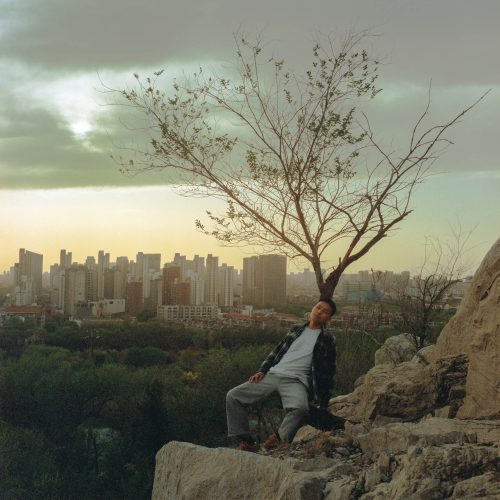
Wei Jinchun chooses a Rolleiflex twin-lens reflex camera, using the concentrated compositions of the square frame and the fine texture of medium-format film to establish a calm, objective tone. By maintaining an “observer’s” distance, he minimizes the prominence of his personal viewpoint, while juxtaposing scenes to create metaphorical tension. In this way, he finds a new aesthetic balance between documentation and interpretation. The sequence of images in the photobook builds a layered narrative: traces of the earthquake, industrial ruins, and everyday street life alternate, inviting viewers to connect details across photographs and actively construct associations and interpretations of history and the present. Together, they convey the enduring legacy of “urban trauma.”
In Tangshan, people’s faces reveal a deep melancholy and a quietly enduring resolve. Historical trauma and the uncertainties of the present converge in these faces, settling into a stillness marked by unspoken pain. In some portraits, Wei Jinchun adopts a deadpan approach to photographing Tangshan’s residents, revealing the resilience and reality of this place through their silent faces. At the same time, the work captures a more exuberant, assertive side of its people: tattooed young men riding Harley-Davidson motorcycles project confidence, defiance, and an air of prosperity, reflecting shifts in outlook brought about by material affluence after the city’s reconstruction. These contrasting expressions suggest underlying divisions and tensions between social classes.
In Wei Jinchun’s views of Tangshan, the scars of history emerge beneath the surface of contemporary prosperity. Through his lens, the urban landscape becomes a theater in which time and space fold into one another. In Nanhu Park, the monumental bronze sculpture Danfeng Chaoyang stands above the turbulent lake and the lakeside pine groves, as silent as a cemetery. Collapsed walls and a memorial inscribed with the names of those who died allow the wounds of history to surface within the fabric of the contemporary city, silently speaking of trauma that cannot be erased. By contrast, newly built high-rises testify to the city’s rapid growth. Yet beneath these gleaming surfaces, remnants of an earlier industrial civilization remain scattered: pale mining sites expose half-excavated mountainsides, sacred figures stand silent in dust-laden caves, and animal bones mingle with bricks and rubble. These scenes seem to voice the earth’s silent accusation, exposing the fractures and scars concealed beneath the appearance of prosperity.
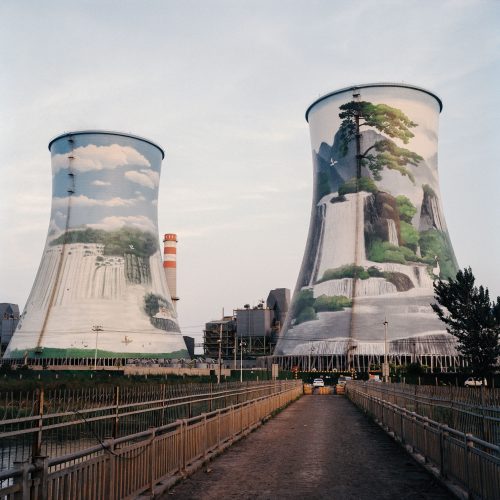
The sharpest critical edge in Wei Jinchun’s photographs lies in the absurd dialogue between reality and illusion. A landscape painted on the exterior of a steelworks cooling tower becomes an imagined vista that conceals industrial scars; behind the ostentatious Baroque facade of a bridal photography studio on a street corner stands the decaying shell of a red-brick warehouse. These deliberately constructed cultural appearances enter into a subtle dialogue with Tangshan’s designation as a “National Civilized City.” On Dachengshan, the surreal conjunction of a headless bodhisattva’s damaged sacred form and newly rising buildings transforms ruptures in historical memory into a striking visual metaphor. Such elements of magical realism lend Tangshan a poetry of the absurd: reality itself shifts subtly before the lens, revealing meanings more complex than those immediately apparent to the eye.
Wei Jinchun’s Tangshan can thus be seen as an example of how contemporary photography engages with historical memory and social critique. Through images, he constructs a system of metaphors rooted in Tangshan’s reality, reflecting tensions between the individual and society, the past and the present. The symptoms of our times emerge in the gaps between images, prompting us to consider the echoes of historical trauma today and the social fractures within ongoing development. Like Walter Benjamin’s “angel of history” gazing at the ruins, Wei Jinchun transforms the rubble and scars of the city’s past into metaphorical images of the present. This visual language goes beyond a personal record of Tangshan, exceeding the bounds of a particular time and place to become an allegorical account of contemporary Chinese society. His work reveals a paradox of urban transformation in China: the polished glass facades of new buildings reflect both the dazzling light of an economic miracle and, inevitably, the shadows of ruins. This duality affirms Adorno’s conception of art as “the social antithesis of society,” establishing a truly contemporary sensibility within the dialectical relationship between progress and trauma.
Liu Gaofeng (Head of the Department of Photography and Associate Professor, Tianjin Academy of Fine Arts)
April 2025
Click the image to view Tangshan