By Xiao Chen
Early this year, while judging submissions to the 13th Ant Photography Award, I came across a group of photographs titled Sunken Land. They held my attention for a long time. I felt that this was a fine body of work, rich in feeling and ideas, and selected it as one of the ten shortlisted entries. Its maker, Wei Jinchun, was a graduate student in the Department of Photography at Tianjin Academy of Fine Arts. Not long afterward, he contacted me again and came to my home with more photographs he had made in Tangshan on film, some in black and white, others in color. He told me that this was a subject he was still photographing. He arrived travel-worn and left in the same way, carrying a helmet and leather knee guards. He said he was about to ride his motorcycle back to Tangshan to continue the work.
Tianjin is close to Tangshan. When the great earthquake struck Tangshan in 1976, Tianjin, where I lived, was among the areas outside the epicenter most severely affected. Many houses collapsed, and there were numerous casualties. I was fourteen then, in my second year of junior high school. Our home was on the fourth floor of an apartment building, and for a full year after the earthquake we did not dare return. With everyone still shaken and fearful, my family, like our neighbors, could only live in a makeshift shelter on the grounds of a nearby school. The following summer, days of torrential rain flooded the shelter and made it impossible to stay. Only then did we summon the courage to move back into our fourth-floor home.
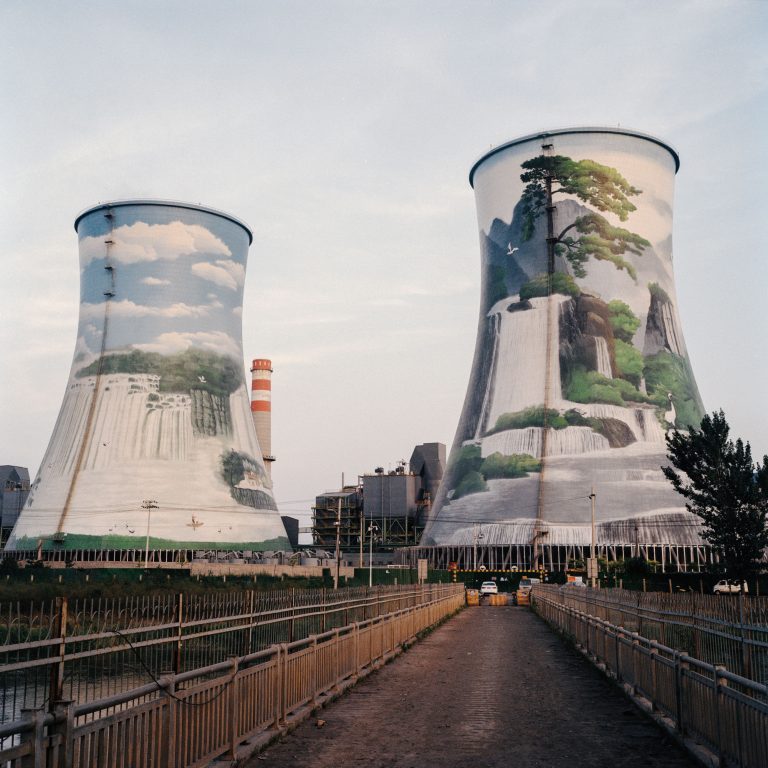
Wei Jinchun is a young man from southern China, born in the 1990s and still in his twenties, whose hometown lies far away in Guangxi. Naturally, he did not experience the great earthquake that struck Tangshan in the north more than forty years ago. But history could tell him much about it. Now studying in nearby Tianjin, he began to think of seeing Tangshan as it is today. He started photographing the city in an area of sunken land. It had once been a coal-mining district, hollowed out underground, that collapsed in the earthquake. In the years since, landscaped waters, artificial hills, and new buildings have gradually appeared, leaving no visible trace of the collapse. Yet the ground that gave way within people’s hearts lives on in their memories and is not so easily made whole.
What can photography show or express about this sunken land? Wei Jinchun’s photographs may offer one of many possible answers. What I see and read in them is not merely an “objective documentation” of its present condition, but, more than that, his deeply subjective touch and reflection. Departing from the traditional stance of social and humanistic documentary photography, he retains the essential qualities of the medium while bringing to it a strong measure of personal feeling, aesthetic inclination, human sympathies and antipathies, the spirit of the times, and even a critical edge. His photographic language is full of symbols and metaphors. Whether people or landscapes, his subjects are both outward realities and images of his inner world, chosen and framed to give it expression. Through this contemporary visual language, I can even discern the many connections and entanglements between history and the present: flourishing yet burdened with pain, bleak and desolate yet accepted as a matter of course.
Amid these human changes across time and space, one can also faintly sense the states of mind of those who live on this sunken land: aged and inexpressive, enduring and compliant, distracted and idle, bewildered and hesitant. In certain landscapes and scenes, meanwhile, newness and decay, accumulated burdens and bombast, survival and burning, polish and superficiality, disorder and stillness, cosmetic concealment and naked exposure convey dramatic tensions at once contradictory and absurd. For Wei Jinchun, photography is clearly a distinctive medium that reaches beyond what words can express. Only through the visual can certain things that defy language be given voice.
Tangshan—a city on the North China Plain that has endured so much pain, a landscape of ruins where the ground once gave way. For years it dared not build tall buildings; for years it would not lick its dry, cracked wounds; for years it growled under its breath or remained silent; for years it needed to be looked upon and touched with kindness. A young photographer from elsewhere braves the cold winds and roams here alone on his motorcycle. What he tells through his lens goes beyond the outward appearance of this utterly transformed city. It is also a sunken place within his own heart that cannot easily be made whole. Perhaps it resonates, too, with his solitude and sense of vastness, with his way of looking anew at the world and at life.
Tianjin, September 22, 2024
Click the image to view Tangshan