Wei Jinchun: Photography Is Not Objective Reality, but It Can Still Lead Us to Truth
December 1, 2023
The results of the fifth 1839 Photography Award have been announced. To offer readers a fuller understanding of the winning works, we have prepared a series of interviews with the recipients of the grand prize and the awards for excellence. Through these conversations, we hope to introduce their work in greater depth and support the further development of their practice.
Interview: Zhang Chenyue Editor: Zhang Chenyue
Originally published on the 1839 Photography Award WeChat public account on December 1, 2023.
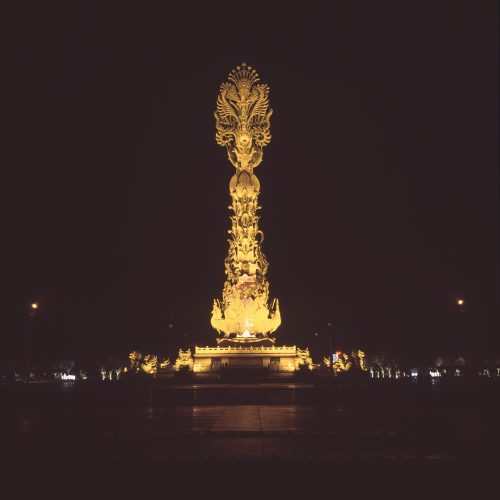
“Phoenix Facing the Sun” bronze sculpture, Nanhu Park, Lunan District, Tangshan, April 2023
1839 Photography Award:While working in Tangshan, which places and experiences made the strongest impression on you, and why?
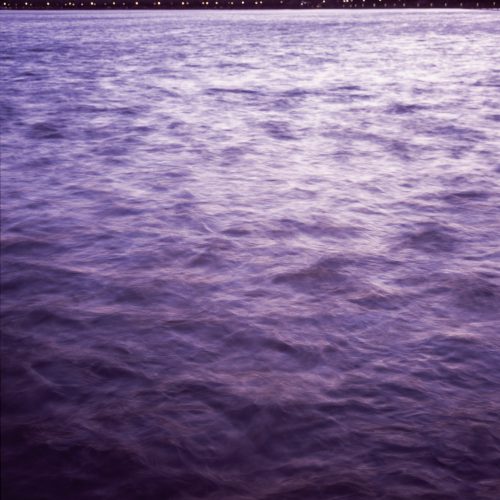
Wei Jinchun: What stays with me most is how I felt on my first visit to Nanhu Park in Tangshan. One weekend after classes resumed following the pandemic, my roommate, who is from Tangshan, took everyone in our dormitory there for a visit. After dinner, we went for a walk in Nanhu Park. He told me that beneath the lake lay one of the main burial sites for many of those who died in the Tangshan earthquake; that the hill beside it was formed from the rubble of collapsed buildings; and that Nanhu itself had been developed from land that subsided during the earthquake. This instantly changed how I felt about the park. As we walked along a quiet path, lights blinked rhythmically over the bleak trees on the hillside. It was as though the entire hill and woodland were breathing in a steady rhythm. The huge lights towering above us seemed like enormous pairs of eyes watching me. A strong wind kept driving the lake water against the shore with a mournful sound, as if Nanhu were sobbing as it told its story…
Beyond these landscapes, which felt like magical realism, the people of Tangshan made the deepest impression on me. Although Tangshan is a small industrial city in northern China, it has a distinctive character, with different social classes and faces.
People in rural Tangshan are very unassuming, almost as if they were living in the last century. They are kind and hardworking, and do not readily give up in the face of hardship…
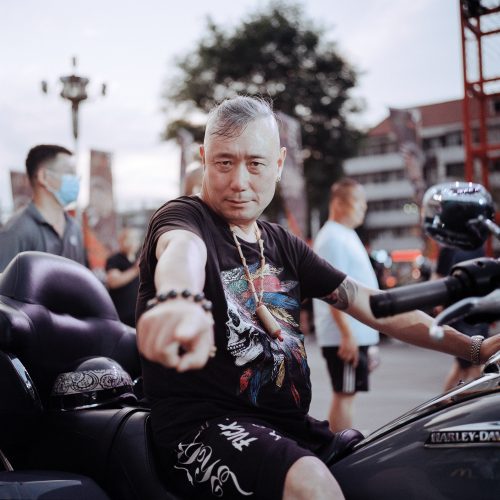
To me, people in urban Tangshan seem quite cosmopolitan. To explain this, I have to start with motorcycles. I am a motorcycle enthusiast and do most of my riding in Beijing. Because traffic police in Beijing and Tianjin are strict about modifications, my motorcycle has none at all. In June, a motorcycle customization festival was held in a commercial plaza in Tangshan. The motorcycles entered in the competition had been extensively modified, and many of the riders had striking tattoos and flamboyant clothes. They had a kind of hippie spirit. I met some fellow riders there, took their photographs, and we agreed to ride together when we had the chance. In July, they invited me on a ride to Zhangbei. Their engines were much larger than mine, so I could only just keep up with the throttle wide open. During that wild, fast ride, I could feel the openhearted, uninhibited spirit of Tangshan’s people.
Earlier, a serious incident involving a very small number of perpetrators had brought a wave of public condemnation down on Tangshan, turning it into a city everyone seemed ready to denounce. But from what I saw during my time photographing there, the people of Tangshan are hardworking, kind, unassuming, and law-abiding. They deserve the same respect as people anywhere else in China.
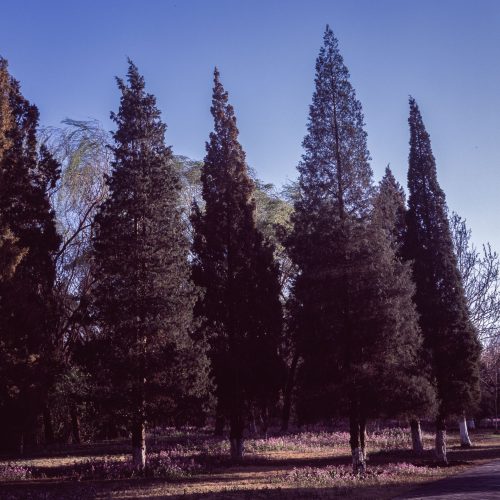
Pine trees above flowers, Nanhu Park, Lunan District, Tangshan, April 2023
Churning lake water after sunset, Nanhu Park, Lunan District, Tangshan, April 2023
1839 Photography Award: Your work shows Tangshan’s new appearance and urban development after the earthquake. What role do you think photography plays in recording a city’s history and changes?
Wei Jinchun: To some extent, photography can record a city’s history and changes and serve as a historical source. But it is not entirely objective or truthful: it carries the photographer’s subjective perspective and limitations. I have therefore not used it as a documentary tool to deliberately record Tangshan’s history and transformation. Instead, I rely on photography to convey my feelings about the city and what I discover while exploring it. For me, photography is a powerful medium.
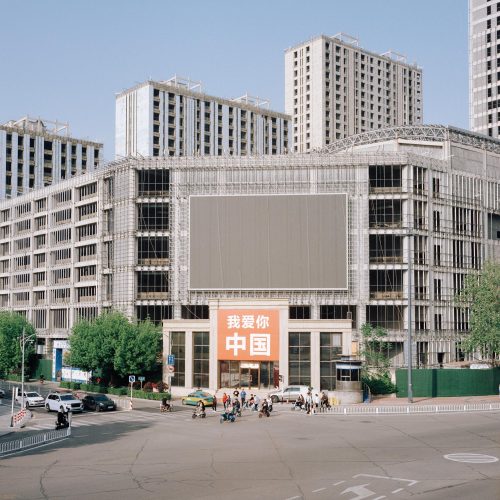
“I Love You, China,” Xinhua Cultural Square, Lunan District, Tangshan, May 2023
1839 Photography Award: Did you talk with the people you photographed? How did they come to agree to be photographed?
Wei Jinchun: I am not an outgoing person, so photographing strangers is something of a challenge for me. At first, people often turned me down. As someone from southern China asking to photograph people in an unfamiliar northern city, I could understandably leave them puzzled. Although my southern accent is not strong, it is clearly different from the Tangshan dialect, so people can immediately tell I am from elsewhere. For the people shown in the work, I generally spoke with them first and photographed them once they agreed. There is also a lovely side to the people of Tangshan: many were happy to be photographed. I added some on WeChat and sent them their pictures; I promised others prints. Many more were willing to appear in the photographs without asking for copies.
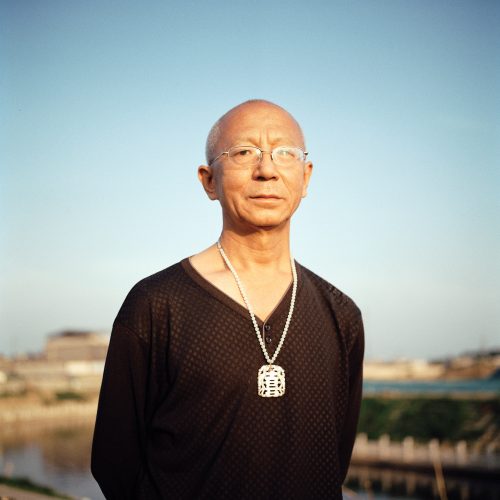
Elderly man wearing a “Double Happiness” pendant in sunlight, Lubei District, Tangshan, May 2023
1839 Photography Award: How do you understand the term “people on the margins”? How is this expressed in your work?
Wei Jinchun: As I understand it, the “margins” necessarily exist in relation to a “center.” People on the margins do not hold power at the center. They neither control society’s decisive resources nor have a voice in shaping its discourse.
I want to focus on individuals among ordinary working people. They reflect a real but little-known side of Tangshan. Each person is a mirror, a book that tells of the city’s distinctive character. I am trying to remind people to pay attention to Tangshan.
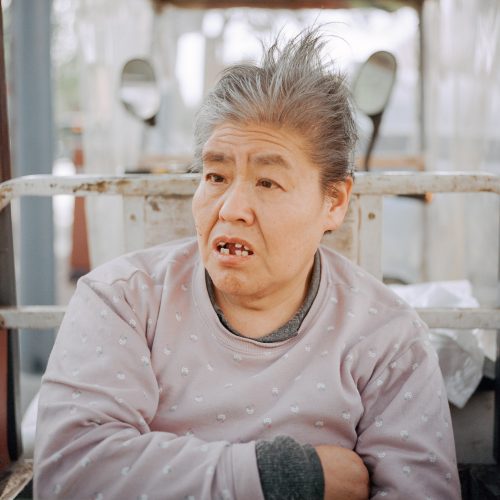
Patient seated on an electric tricycle, Tangshan, May 2023
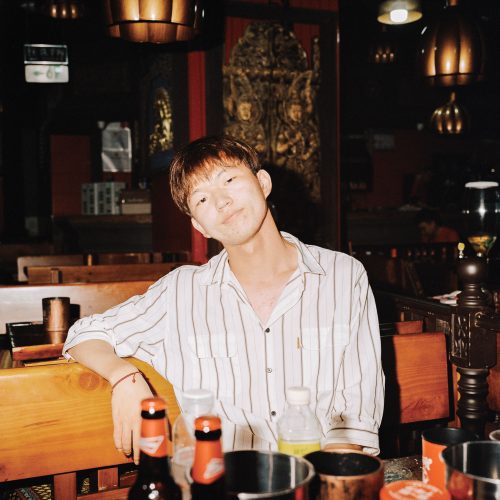
Young man at Helens, Lubei District, Tangshan, June 2023
1839 Photography Award: Could you describe your experience of revisiting the history of the Tangshan earthquake at the earthquake museum? How did it affect your photographic work?
Wei Jinchun: To be honest, what I knew about the Tangshan earthquake had come from textbooks. My impressions were largely formed by words. It was only when Tangshan repeatedly appeared among trending news topics in recent years that I began to pay attention to it. Visiting the earthquake site in person moved me deeply. Countless names were engraved on the enormous memorial wall, with wreaths laid below and people coming to pay their respects. History and the present intertwined. These symbols and memories together formed my particular impression of Tangshan.
Today, industrial transformation and imbalances in economic and cultural development also shape the distinctive character of contemporary Tangshan. These are precisely the subjects I want to photograph and the questions I want my work to raise.
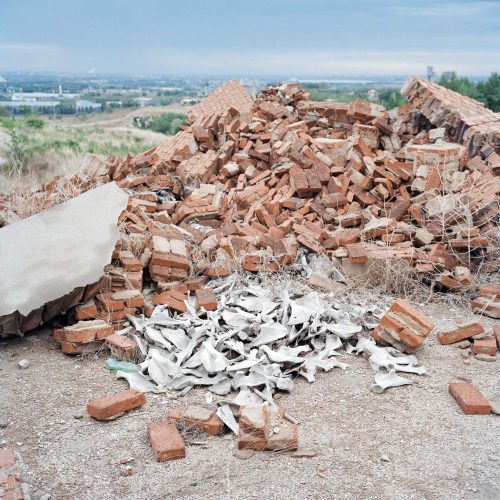
Bones and ruins, Shuangqiao Town, Kaiping District, Tangshan, June 2023
1839 Photography Award: What role do you take in making the work—a judge, or an observer?
Wei Jinchun: I am definitely an observer. In our time, artists are also among those on the margins, a vulnerable group. I build the work around my own observations in Tangshan, trying to convey its inner life and present circumstances…
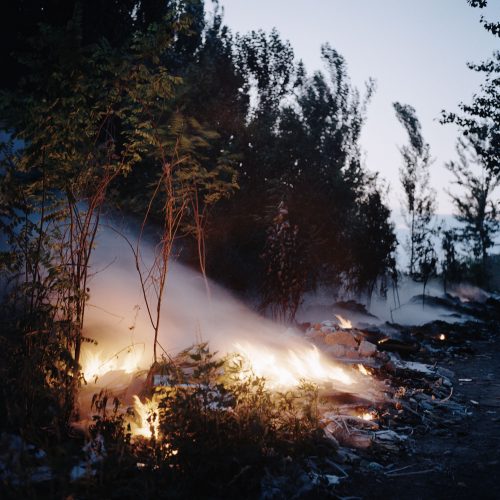
Roadside wildfire, Kaiping District, Tangshan, June 2023
1839 Photography Award: How do you view truth and subjectivity in photography? How do you maintain objectivity and truthfulness when photographing?
Wei Jinchun: In Susan Sontag’s account, humanity remains irredeemably in Plato’s cave, unable to see reality yet captivated by “images of reality.” We tend to treat the apparent reality on the surface of a photograph as objective reality, mistaking the photograph for the thing photographed. But photography itself is not objective reality: it inevitably incorporates the photographer’s subjective intentions and interpretations. In Tangshan, I work through straight photography, taking images directly from the real world. That does not mean they are equivalent to objective reality. I do not think photographing has to follow a principle of objective truth; I am more concerned with conveying subjective truth. This relates to Bazin’s understanding of reality and realism: the “truth” in a work need not be the truth of external reality; it can be a truth of expression. He emphasizes the maker’s subjective truth and creative intent. Although photography is not equivalent to objective reality, it can still take us toward truth. Through photography, we can question the real world and convey the underlying nature of what is true.
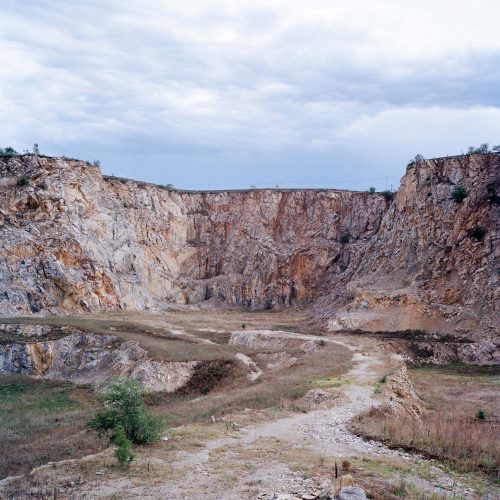
Excavated mountainside, Shuangqiao Town, Kaiping District, Tangshan, June 2023
1839 Photography Award: How has photographing in Tangshan influenced your understanding of photography and your approach to making work?
Wei Jinchun: Perhaps everyone understands photography differently at different stages. At this point, while working on Tangshan, my supervisor has had a considerable influence on how I think about making work. He places great emphasis on photography’s influence on society and its ability to shape our understanding of history. This understanding of photography provides an underlying support for my practice.
When I first began photographing, my approach was largely to give outward form to subjective feelings. Nanhu and many of the earthquake sites stirred emotions in me that I could not quite explain, and there was always a hint of sadness in the photographs. As the work progressed, I began to observe more of Tangshan as it is today, beyond its historical events. I increasingly recorded the world I saw, wanting to present Tangshan as I experienced it through cross-sections of its social life.
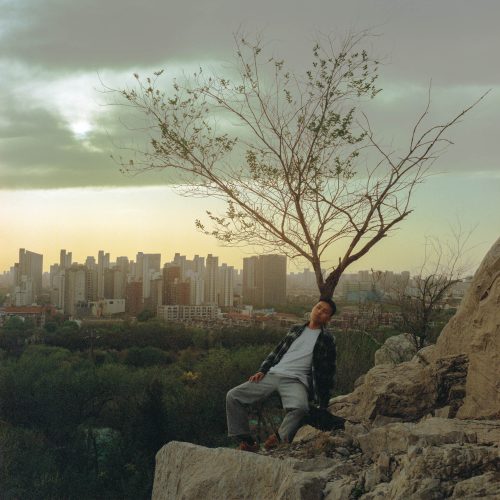
Young man leaning against a tree, Dachengshan Park, Lubei District, Tangshan, April 2023
Tangshan Harley Motorcycle Club, Taiyangcheng, Lubei District, Tangshan, June 2023
1839 Photography Award: Will you continue to focus on Tangshan?
Wei Jinchun: I have not been photographing Tangshan for very long, and the project is still developing. I study in Tianjin, about 100 kilometers from Tangshan. After my first visit, I rented a small place there. From then on, I rode my motorcycle from Tianjin to Tangshan every weekend to photograph. During the first two or three months, I went quite frequently; afterward, I went whenever I could find time. I will continue to work on it in greater depth. Ultimately, I want Tangshan to present the city from my perspective.
I also want to respond to a question raised by a juror in their commentary. Tangshan is actually a photobook. Through images arranged in different chapters, it conveys my feelings about Nanhu Park and Tangshan, the historical background of the earthquake, contemporary life in the city, its mining industry, and the circumstances in which its people live. There is a very clear internal logic. The difficulty may lie in selecting a small number of images from an existing book for submission—twenty photographs, for example. That imposes a constraint, though of course it is also part of entering a competition.
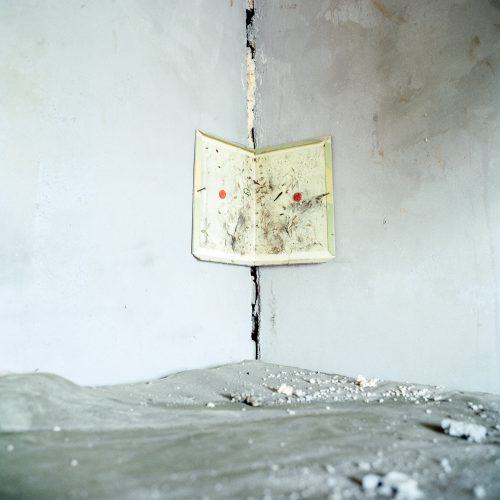
Cracks and a glue trap on a workers’ dormitory wall, Guye District, Tangshan, July 2023
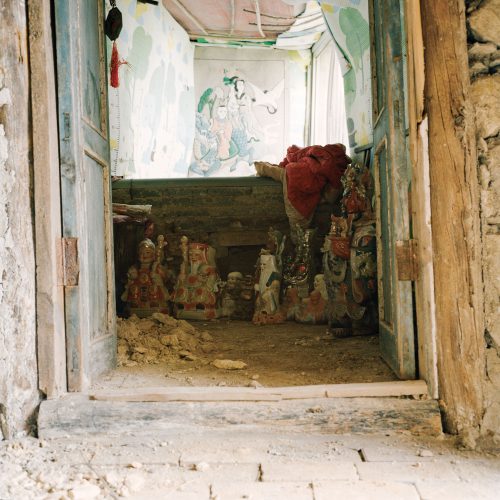
Statues of deities piled on the ground in a cave, Fengshan, Shuangqiao Town, Kaiping District, Tangshan, June 2023
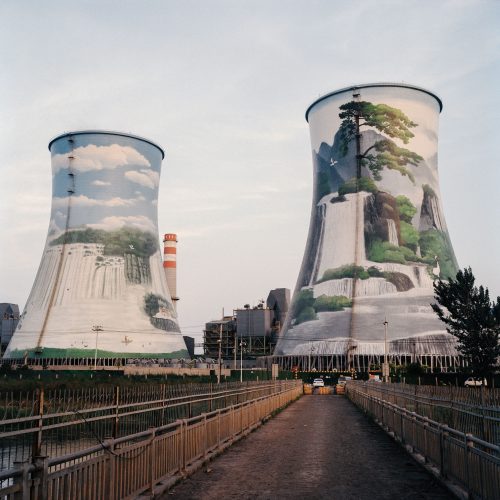
Cooling tower painted with a landscape, hot-rolling plant, Tangshan Ganglu Iron&Steel Co., Ltd., Zunhua, Tangshan, July 2023
The 1839 Photography Award is an independent, nongovernmental initiative founded by individuals. Named for the year of photography’s invention, it returns to the medium’s defining properties while remaining open to its expansion across media. Open to students of Chinese heritage enrolled at universities worldwide, the award seeks to examine the understanding and judgment developed through their creative work and artistic training. It brings together a jury of established curators, publishers, researchers, critics, and artists. Both the jury and the organizing team work without remuneration. Judging the submitted works on their merits, the jury selects projects that demonstrate independent thinking and artistic potential, with the aim of strengthening students’ independence and capacity for artistic expression. Through critical writing, exhibitions, and other forms of presentation, the award introduces the public to current work by emerging students of Chinese heritage around the world. It also encourages exchanges of experience and mutual support among student photography communities in China and internationally.
Founder: Dong Jun; Co-founder: Hai Jie Secretary-General: Bai Qian; Project Coordination: Luo Kai Interns: Hu Mengnan, Shi Yang, Zhang Yue, and Zhang Chenyue English Translation: Yao Fangyuan